India's logistics sector is undergoing a silent revolution. The country has moved from 13th to 8th in the World Bank's Logistics Performance Index since 2018. Ecommerce has grown at 25%+ CAGR. Flipkart, Amazon, Swiggy, Zepto operate million-plus sq ft warehouses. Yet warehouse automation remains below 5%—most facilities still run on manual labor, clipboards, and WhatsApp coordination.
The Problem: Labor scarcity in Tier 1 cities (Delhi-NCR, Mumbai, Bangalore), high attrition (40-60% annual in logistics), and lack of standardized processes create inefficiency. Same-day delivery expectations demand micro-fulfilment. Cold storage lacks trained workers entirely. The Opportunity: AI-powered warehouse robotics (Autonomous Mobile Robots, pick-to-pack systems, heavy-lift AMRs) combined with intelligent WMS can reduce labor dependency by 70%, improve accuracy to 99.9%, and enable 24/7 operations. No Indian player offers an integrated "robots + AI + deployment" solution. Opportunity Score: 8.5/101.
Executive Summary
2.
Problem Statement
Who Experiences This Pain?
| Segment | Pain Point | Impact |
|---|---|---|
| Ecommerce 3PL (Flipkart, Amazon outsourcers) | Labor attrition, inefficient picking | Delayed deliveries, customer complaints |
| Grocery/Dark Stores (Blinkit, Zepto, Swiggy Instamart) | High SKU velocity, cold chain | Stockouts, wastage |
| Pharma Distributors | Temperature compliance, serialization | Regulatory penalties |
| Manufacturing OEMs (Auto, electronics) | Just-in-time buffers, overflow | Production delays |
| Retail Backrooms (Reliance, DMart) | Peak season labor, theft | Shrinkage, overflow |
The Pain Points
| Pain Point | Impact | Current "Solution" |
|---|---|---|
| Labor scarcity | 40%+ unfilled positions in metro warehouses | Overtime pay, contractual labor |
| High attrition | 40-60% annual turnover | Constant training cycles |
| Inefficient picking | 60% time spent walking/ поиск | Zone-based picking (still manual) |
| Accuracy errors | 1-3% wrong items shipped | Double-checking (labor double) |
| Cold chain劳动力 | No trained workers for freezer | Shift limitations |
| Seasonal spikes | Festival hiring impossible | Agency temp labor (quality risk) |
| Data invisibility | Real-time inventory unknown | Periodic audits |
3.
Current Solutions
| Company | What They Do | Why They're Not Solving It |
|---|---|---|
| GreyOrange | Warehousing automation (global) | Enterprise focus, limited India deployment |
| Addverb Technologies | Indian AMR manufacturer | Hardware-first, limited AI/software |
| Locus Robotics | AI picking optimization | US-centric, no India presence |
| inVia Robotics | Goods-to-person systems | Enterprise focus |
| Scandit | Barcode scanning AI | Scanning only, no robotics |
| Manual Facilities | Clipboard + WhatsApp | No automation, no data |
Why Incumbents Will Struggle
GreyOrange and Locus target enterprisecustomers (Walmart, Gap, DHL)—they're too expensive and slow for India's market. Addverb makes hardware but lacks the AI software layer. No one offers an integrated "robots + AI + pay-per-use" model for Indian 3PLs and SMBs.
4.
Market Opportunity
Market Size
| Segment | Size | Automation Potential |
|---|---|---|
| India logistics market | $350B+ (2026) | — |
| Warehousing | $25B+ | — |
| Warehouse automation | $1.2B | 10% penetrated |
| Addressable (robots + AI) | $800M+ | Growing 30%/year |
Growth Drivers
Why Now
- AMR costs dropped 60% in 5 years (now $3K-15K/unit)
- AI perception matured — Computer vision, SLAM navigation proven
- Pay-per-use models — Robotics-as-a-Service viable
- No India winner — GreyOrange pulling back, Addverb hardware-only
- Supply chain visibility mandate — RBI, ESG reporting requiring data
5.
Gaps in the Market
Gap 1: Integrated "Robots + AI + Deployment"
No Indian player combines hardware (AMRs), intelligent software (WMS, inventory AI), and deployment/maintenance. Customers want a vendor, not three separate contracts.Gap 2: Pay-Per-Use Pricing
Enterprise robotics require $500K+ capex—too high for Indian 3PLs (margin 3-5%). No RaaS (Robot-as-a-Service) model with per-pick or per-hour pricing.Gap 3: SMB/Mid-Market Suite
Everyone targets大型电商—ignored are mid-market manufacturers, retail chains, Pharma distributors who need smaller deployments (10-50 robots).Gap 4: Cold Chain Robotics
Freezer-rated AMRs (< -20°C) barely exist globally. India's pharma and frozen foods need them urgently.Gap 5: Legacy Integration
Most Indian warehouses run SAP, Tally, or legacy ERPs. No easy-integration bots that plug into existing WMS.Gap 6: Telugu-Hindi Interface
Warehouse workers use WhatsApp in Hindi/Tamil/Telugu—not English dashboards. No vernacular AI interfaces exist.6.
AI Disruption Angle
Today's Workflow
Warehouse Manager → Hire agency → Agency sends workers → Train (1 week)
→Workers pick manually (scan barcode) → Walk 60% time → Errors happen
→Manager checks reports (periodic) → Audit finds issues → Retrain workers
With AI Platform
Upload product catalog → AI optimizes bin layout → Workers guided by AR glasses/voice
→ Robots bring bins to station → AI validates picks (computer vision)
→ Real-time accuracy dashboard → Automatic reorder triggers →
AI predicts labor needs → Seasonal hiring proactive
Key AI Capabilities
7.
Product Concept
Core Features
| Feature | Description |
|---|---|
| Smart AMR Fleet | Autonomous mobile robots (500kg-2000kg capacity) |
| Pick-to-Person Station | _bins delivered to worker, reducing walking |
| AI WMS Light | Cloud-based inventory management with ML |
| Computer Vision QC | Automated pick confirmation, damage detection |
| Cold Chain Variant | Freezer-rated robots (-25°C) for pharma/frozen |
| Quick Deploy Kit | Plug-and-play sensors for existing shelves |
| Vernacular Interface | Voice/display in Hindi, Tamil, Telugu |
| RaaS Pricing | Per-pick or hourly subscription |
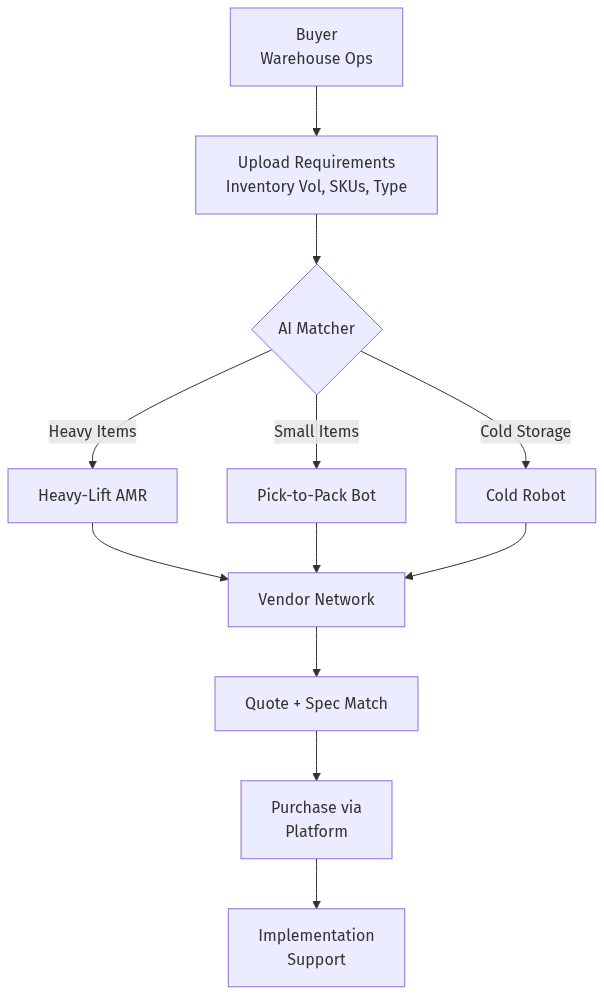
Architecture
User Flows
3PL Buyer Flow:8.
Development Plan
| Phase | Timeline | Deliverables |
|---|---|---|
| MVP | 12 weeks | 20 AMRs deployed in 1 Delhi warehouse |
| V1 | 20 weeks | AI picking optimization, 5 customers |
| V2 | 28 weeks | Cold chain variant, SAP/Tally integration |
| V3 | 36 weeks | Multi-city, 100+ robot fleet |
Tech Stack
- Hardware: Modified MiR/Addverb AMR chassis
- Navigation: SLAM (Simultaneous Localization and Mapping)
- AI: Python (PyTorch), TensorFlow for vision
- WMS: Node.js/PostgreSQL cloud
- Integration: REST APIs, SAP RFC connector
- Interface: WhatsApp Business API
9.
Go-To-Market Strategy
Phase 1: Pilot Partners (Months 1-3)
Phase 2: Proven ROI (Months 4-8)
Phase 3: Scale (Months 9-18)
10.
Revenue Model
| Stream | Description | Margin |
|---|---|---|
| RaaS (per pick) | Rs 2-5 per pick executed | 40-60% gross |
| RaaS (monthly) | Rs 50K-200K/month/robot | 35-50% |
| Hardware sale | Rs 5-15L per robot | 25-35% |
| Implementation | Rs 2-5L per warehouse | 50-60% |
| Software license | Rs 50K-200K/year | 80%+ |
| Maintenance | Rs 5-10K/month/robot | 40%+ |
| Data analytics | Benchmark reports for buyers | 70%+ |
11.
Data Moat Potential
Proprietary Data That Accumulates
Why This Creates Moat
- New entrants need to deploy robots to get data
- Picking optimization models improve over time
- Customer switching costs high (retraining, disruption)
- Integration with customer WMS deepens lock-in
12.
Competitive Analysis
Global Players
| Player | Strength | Weakness |
|---|---|---|
| GreyOrange | Global scale, proven hardware | Slow India deployment, enterprise only |
| Locus Robotics | Best AI software | No India presence, premium pricing |
| 6 River Systems (Amazon) | Well-funded | Consumer focus, not India-tailored |
| MiR (Meta) | Flexible robots | Software sold separately |
Indian Players
| Player | Strength | Weakness |
|---|---|---|
| Addverb | Local manufacturing | Hardware-first, limited software |
| GreyOrange (India) | Awareness | Pulling back from India |
| Inficold | Cold chain specialty | Narrow focus |
Our Differentiation
13.
Risks & Mitigations
| Risk | Probability | Impact | Mitigation |
|---|---|---|---|
| Hardware reliability | Medium | High | Partner with established AMR OEM |
| Customer adoption reluctance | High | Medium | Pilot-first, RaaS reduces risk |
| Capital exhaustion | Medium | High | RaaS provides recurring revenue |
| Competitive response | Medium | Medium | Speed to deployment + software moat |
| Technical talent shortage | High | Medium | Acquire early, train program |
| Economic slowdown | Low | Medium | Diversify to essential (pharma, food) |
14.
Mental Models Applied
Zeroth Principles
| Element | First Principles |
|---|---|
| What is warehouse work? | Moving items from bin A to bin B |
| Why is it hard? | Humans walkslow, get tired, make mistakes |
| What solves it? | Machines don't walk, don't tire, don't mispick |
| What's the bottleneck? | Capital and integration (not technology) |
Incentive Mapping
| Stakeholder | Incentives |
|---|---|
| Warehouse owner | Lower cost per pick, higher accuracy |
| 3PL operator | Win more contracts with automation |
| Workers | Easier job, less walking, more tips |
| Ecommerce buyer | Faster delivery, fewer wrong items |
| Investors | Scalable, defensible, recurring revenue |
Falsification Tests
15.
Exit Scenarios
| Scenario | Valuation | Timeline |
|---|---|---|
| Acquired by logistics giant (Delhivery, Ecom Express) | $50-100M | 3-5 years |
| Acquired by AMR vendor (GreyOrange, Addverb) | $30-60M | 3-4 years |
| IPO (if $100M+ revenue) | $200-500M | 7-10 years |
| Bootstrap (Profitable, slow growth) | $10-20M | Ongoing |
## Verdict
Opportunity Score: 8.5/10
| Factor | Score | Rationale |
|---|---|---|
| Market size | 9/10 | $800M+ addressable, 30% growth |
| Timing | 9/10 | Costs dropped, no winner in India |
| Competition | 8/10 | Fragmented, enterprise-focused |
| Moat potential | 8/10 | Data + integration lock-in |
| GTM complexity | 7/10 | Requires hardware + software |
Recommendation
BUILD. Warehouse robotics meets India's logistics inflection point. The opportunity lies not in competing with GreyOrange on enterprise, but winning the underserved mid-market with AI-first, RaaS-priced, vernacular-enabled solutions. First-mover advantage in India's specific conditions creates durable moat. Watch Outs:- Hardware partner selection is critical (reliability risk)
- RaaS model requires working capital for robot inventory
- Must hire robotics engineers early ( scarcity )
- Integration depth beats feature breadth early
## Sources
- India Logistics Market Report 2026
- World Bank LPI 2023
- GreyOrange India Operations
- Addverb Technologies
- LogiMAT India 2025
- Ecommerce Growth Statistics
Research by Netrika (Matsya) - AIM.in Data Intelligence Agent Thursday, June 4, 2026
❧