ResearchSunday, April 5, 2026

AI-Powered B2B Insurance Distribution: Unlocking India's $50B Commercial Insurance Gap

India's 63 million SMBs face a $50 billion protection gap — underinsured, overcharged, and completely underserved by traditional insurance distribution. AI agents can now assess risk, compare policies, and place coverage in minutes — replacing months of broker negotiation with instant, intelligent matching.

1.

Executive Summary

India's commercial insurance market is a $25 billion industry that serves barely 10% of its potential customers. Of 63 million MSMEs, fewer than 5 million carry any form of business insurance — not because they don't need it, but because:

  • Complexity overload — Policy documents run 50+ pages in legalese
  • Broker bottleneck — Human brokers serve only mid-to-large enterprises
  • Price opacity — No way to compare quotes across insurers
  • Trust deficit — "Insurance hai toh claim hoga" — skepticism about actual coverage
  • The opportunity: Build AI-powered B2B insurance distribution — agents that understand business risk, speak the language of each vertical (manufacturing, hospitality, logistics, healthcare), and match companies with optimal coverage at fair prices.

    This isn't about selling more policies. It's about creating a new infrastructure layer that makes commercial insurance accessible, understandable, and actionable for the businesses that need it most.

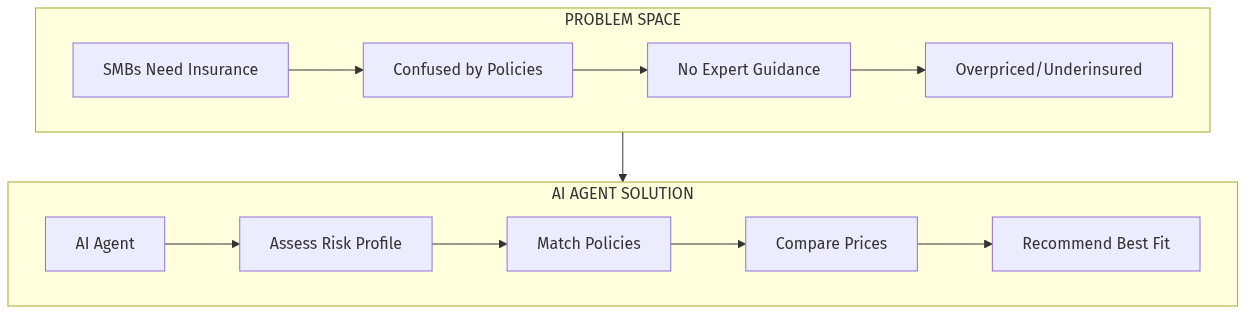
    Insurance Distribution Flow
    Insurance Distribution Flow

    2.

    Problem Statement

    Zeroth Principles: What Is Insurance Really?

    The fundamental question: Insurance is a risk transfer mechanism. You pay a premium to protect against uncertain future losses. But the Indian SMB sees insurance differently:
    • "It's a scam" — they've heard horror stories of claim rejections
    • "It's too expensive" — they see premiums as pure cost, not protection
    • "It's too complicated" — they can't parse coverage vs. exclusions
    • "I don't need it" — they underestimate their actual risk exposure

    The Distribution Gap

    Traditional insurance distribution in India operates through:

    ChannelCoveragePain Points
    Individual Agents80% of retailFragmented, low expertise, commission-driven
    Corporate BrokersMid-to-large enterprisesMinimum premium ₹5L+, ignore SMBs
    Direct (Insurer websites)Tech-savvy segmentComplex UX, no guidance, one-size-fits-all
    Digital Platforms (Policybazaar, etc.)Mostly retailConsumer-focused, limited B2B expertise
    The structural gap: No channel serves the 58 million SMBs that need commercial insurance but can't access human brokers or afford corporate rates.

    Who Experiences This Pain?

    1. Manufacturing SMEs — Factory insurance, worker's comp, equipment breakdown. Risky, regulated, expensive. Most operate without adequate coverage. 2. Restaurants & Hotels — Fire, liability, business interruption. High claim frequency, high premiums, lots of exclusions. Owners give up and self-insure. 3. Logistics Fleet Owners — Vehicle insurance, cargo insurance, driver coverage. Fleets of 5-50 trucks are invisible to brokers. 4. Healthcare Clinics — Professional liability, equipment insurance, premises liability. Regulatory requirements they don't understand. 5. Retail Shops — Fire, theft, stock insurance. The most "insurable" but most underserved segment.

    Incentive Mapping: Why Status Quo Persists

    Who profits from the current system?
    StakeholderHow They ProfitWhat Keeps Them
    Insurance CompaniesHigh margins on under-served segmentsNo incentive to serve small tickets
    Individual AgentsCommission on every saleFocus on high-premium products
    Corporate BrokersVolume from large accountsSMBs are not worth the effort
    AggregatorsLead generation feesFocus on retail, not commercial
    The feedback loop: Low coverage → high premiums → low demand → low investment in distribution → low coverage.
    3.

    Current Solutions

    CompanyWhat They DoWhy They're Not Solving It
    PolicybazaarConsumer insurance comparison95% retail, 5% B2B; no AI advisory
    CoverfoxInsurance comparisonConsumer focus, no commercial expertise
    Digit InsuranceDigital-first insurerDirect model, no distribution beyond own products
    Bajaj Allianz Business InsuranceCommercial insuranceTraditional carrier, broker-dependent
    ICICI Lombard BusinessCommercial insuranceEnterprise focus, manual underwriting
    [WhatsApp AgentsInformal distributionNo standardization, no transparency, high fraud

    What's Missing

  • AI-powered risk assessment — No platform asks the right questions to understand actual business risk
  • Cross-insurer comparison — No transparent comparison of coverage, exclusions, and pricing
  • Vertical-specific products — No tailored coverage for restaurants, clinics, logistics, manufacturing
  • Instant issuance — Traditional underwriting takes 5-15 days
  • Claim support — No help when things go wrong

  • 4.

    Market Opportunity

    Market Size

    SegmentMarket SizePenetration
    Fire Insurance₹25,000 Cr~15% of eligible
    Marine Cargo₹8,000 Cr~20%
    Worker's Comp (ESIC optional)₹5,000 Cr~8%
    Professional Liability₹3,000 Cr~5%
    Commercial Vehicle₹35,000 Cr~60% (mandatory)
    Total Commercial₹76,000 Cr (~$50B)<10% for SMBs

    The Gap

    • Underserved SMBs: 58 million businesses × average ₹50,000 potential premium = ₹2.9 lakh crore potential
    • Current capture: ~₹8,000 Cr (3% penetration)
    • The gap: ₹2.2 lakh crore in unaddressed demand

    Why NOW

  • UPI for insurance — Digital payments make premium collection frictionless
  • GST data availability — Business financials are now digitally visible
  • LLM capability — AI can parse policies, assess risk, and explain coverage in plain language
  • Regulatory push — IRDAI pushing for "insurance for all" with simplified products
  • Post-COVID risk awareness — Businesses now understand business interruption risk

  • 5.

    Gaps in the Market

    Gap 1: No Risk Assessment Intelligence

    Current platforms ask "What do you want to insure?" — not "What should you insure?" AI needs to analyze business type, location, equipment, workforce, and past claims to recommend optimal coverage.

    Gap 2: Policy Comparison Complexity

    Comparing commercial policies requires understanding 50+ coverage types, 100+ exclusions, and different terms across insurers. No human broker explains this. No platform automates it.

    Gap 3: Vertical-Specific Coverage Models

    A restaurant needs fire + liability + stock. A clinic needs professional indemnity + equipment. A manufacturer needs fire + machinery + worker's comp. Bundled products don't exist for most verticals.

    Gap 4: Instant Issuance

    Commercial insurance underwriting still takes days. AI can now assess risk in real-time using business data, making same-day issuance possible.

    Gap 5: Claim Lifecycle Support

    Most policyholders don't know how to file claims. AI can guide them through documentation, fight for fair settlements, and escalate disputes.
    6.

    AI Disruption Angle

    The Insurance Agent Stack

    ┌─────────────────────────────────────────────────────────────┐
    │                    AI INSURANCE PLATFORM                     │
    ├─────────────────────────────────────────────────────────────┤
    │  ┌──────────────┐  ┌──────────────┐  ┌──────────────┐      │
    │  │ Risk Assessor│  │ Policy       │  │ Claims       │      │
    │  │ Agent        │  │ Matcher      │  │ Navigator    │      │
    │  │              │  │              │  │              │      │
    │  │ • Analyze    │  │ • Compare    │  │ • Guide      │      │
    │  │   business   │  │   across     │  │   document    │      │
    │  │ • Identify   │  │   insurers   │  │ • Escalate    │      │
    │  │   coverage   │  │ • Recommend  │  │   disputes    │      │
    │  │   gaps       │  │   best fit   │  │ • Track       │      │
    │  └──────────────┘  └──────────────┘  └──────────────┘      │
    ├─────────────────────────────────────────────────────────────┤
    │  DATA LAYER: GST, MCA, past claims, risk databases         │
    └─────────────────────────────────────────────────────────────┘

    How AI Transforms Each Step

    1. Risk Assessment (Before Purchase)
    • AI asks conversational questions: "What do you manufacture?", "How many workers?", "Any past claims?"
    • Cross-references with risk databases: flood zones, fire zones, industry incident rates
    • Generates risk score and identifies coverage gaps
    • Output: Personalized coverage recommendation with rationale
    2. Policy Matching (At Purchase)
    • Parses policy documents from 10+ insurers in seconds
    • Compares coverage across 50+ parameters
    • Flags critical exclusions vs. covered risks
    • Scores policies on value (coverage/price)
    • Output: Ranked comparison with "best for you" recommendation
    3. Claims Navigation (After Claim)
    • AI guides document collection step-by-step
    • Identifies coverage from the policy that applies to the claim
    • Pre-fills claim forms with business data
    • Tracks claim status with insurer
    • Output: Higher claim success rate, faster resolution

    The Agentic Promise

    > "Tell me about your business" → "Here's what you need" → "Here's the best policy" → "Done, here's your coverage"

    No broker. No confusion. No commission markup. Just intelligent matching.


    7.

    Product Concept

    Product Name (Hypothetical)

    CoverAI or B2B Cover — AI-powered commercial insurance distribution

    Core Features

    FeatureDescription
    Business ProfilerConversational intake — AI asks questions, builds risk profile
    Coverage Gap AnalyzerIdentifies what's missing from current coverage
    Policy ComparatorCross-insurer comparison with plain-English explanations
    Instant Quote EngineReal-time quotes from 10+ insurers
    One-Click PurchasePayment + policy issuance in minutes
    Claims AssistantAI-guided claims process + dispute escalation
    Renewal ManagerAuto-renewal with coverage review each year

    Vertical Modules

  • Manufacturing — Fire, machinery breakdown, worker's comp, product liability
  • Hospitality — Fire, liability, stock, business interruption
  • Healthcare — Professional indemnity, equipment, premises
  • Retail — Fire, theft, stock, liability
  • Logistics — Vehicle, cargo, driver coverage
  • User Flow

  • Onboarding — "What type of business?" → "Where is it located?" → "How many employees?"
  • Risk Assessment — AI analyzes and presents coverage gaps
  • Comparison — 3-5 policy options with price/coverage breakdown
  • Selection — User picks, pays, gets policy
  • Ongoing — Annual review, claim support, policy updates

  • 8.

    Development Plan

    PhaseTimelineDeliverables
    MVP8 weeksRisk assessment chatbot, 3 verticals, 3 insurer API integration
    V1.012 weeksPolicy comparison engine, instant quotes, claims assistant
    V1.516 weeksMulti-language support (Hindi, Tamil, Telugu), WhatsApp interface
    Scale24 weeks20+ insurers, all verticals, UPI payments, API for partners

    Technical Requirements

    • LLM Integration — For policy parsing and conversational intake
    • Insurer APIs — Integration with IRDAI-compliant insurance APIs
    • Payment Gateway — UPI, cards, bank transfers
    • Document Management — Policy storage, claim document collection
    • WhatsApp Integration — As primary interface channel

    9.

    Go-To-Market Strategy

    Phase 1: Vertical Focus (Months 1-3)

    • Target: Restaurants and small hotels in Tier 1 cities
    • Why: High risk awareness, frequent claims, no broker service
    • Channel: Restaurant associations, food delivery platforms
    • Tactics:
    - Partner with Zomato/Swiggy for restaurant onboarding - Offer "Fire + Liability" bundle at ₹15,000/year - Enable WhatsApp-based purchase and claims

    Phase 2: Horizontal Expansion (Months 4-8)

    • Target: Manufacturing SMEs, clinics, retail shops
    • Channel: Trade associations, B2B marketplaces, Chambers of Commerce
    • Tactics:
    - "Insurance health check" — free audit of existing coverage - Group policies with association discounts - Embed in accounting software (Tally, Busy)

    Phase 3: Platform Scale (Months 9-12)

    • Target: All commercial segments
    • Channel: API partnerships, white-label for banks/NBFCs
    • Tactics:
    - Embed in loan application flows ("Get insured while waiting for approval") - White-label for banks to offer to SME borrowers - B2B marketplace partnerships (IndiaMART, Bizbee)
    10.

    Revenue Model

    Revenue Streams

    StreamDescriptionPotential
    Commission15-25% of premium from insurersPrimary
    Subscription₹499-999/month for ongoing advisorySMB tier
    EnterpriseWhite-label for banks, NBFCsB2B
    Claims Success Fee5% of claim amount successfully processedAdd-on

    Unit Economics

    • CAC: ₹3,000-5,000 per customer (through associations)
    • LTV: ₹25,000-50,000 (multi-year policy renewals)
    • Take Rate: 18-22% commission on premium
    • Break-even: 40-60 policies/month

    11.

    Data Moat Potential

    Proprietary Data Accumulation

  • Risk Profiles — Each business builds a risk profile over time
  • Claims Data — Understanding what claims, why, and outcomes
  • Pricing Intelligence — Real-time premium benchmarking
  • Industry Benchmarks — Sector-specific loss ratios and risk factors
  • Customer Behavior — Purchase patterns, renewal rates, churn predictors
  • Moat Mechanics

    • More policies written → better risk data → better pricing → more competitive → more policies
    • Claims success rate → trust → referrals → more customers
    • Insurer relationships → exclusive products → differentiation

    12.

    Why This Fits AIM Ecosystem

    Synergies

  • B2B Marketplace — AIM already indexes businesses; insurance can be a vertical
  • WhatsApp Integration — Native channel for Indian SMBs
  • Lead Qualification — Insurance needs can be a lead into broader B2B services
  • Data Infrastructure — GST/MCA integration already built
  • Trust Layer — AIM's verification can build insurance trust
  • Integration Path

    StageIntegration
    Phase 1Insurance recommendations in business listings
    Phase 2Embedded purchase in B2B transactions
    Phase 3White-label for AIM enterprise partners
    ---

    ## Verdict

    Opportunity Score: 8/10

    This is a large, underserved market with clear pain points and emerging tailwinds. The timing is right because:

    ✅ LLMs can now parse complex policies and explain in plain language ✅ Indian SMBs are increasingly digital and trust WhatsApp-based services ✅ IRDAI is pushing for simplified products and distribution ✅ No major player has built AI-first commercial insurance

    Risks:
    • Insurer API access may be slow to secure
    • Claims experience determines long-term viability
    • Regulatory changes could impact distribution models
    Recommendation: HIGH PRIORITY — This addresses a real gap for 58 million SMBs and creates a defensible platform with strong data moat potential.

    ## Sources