ResearchFriday, April 3, 2026

AI-Powered B2B Industrial Safety & PPE Marketplace: India's $15B Unstructured Opportunity

India's industrial safety market — Personal Protective Equipment (PPE), safety gear, fall protection, fire safety — is a $15+ billion market dominated by fragmented dealers, WhatsApp negotiations, and opaque pricing. AI agents can structure this market, automate procurement, and create the first vertical B2B platform for workplace safety.

1.

Executive Summary

India's industrial safety and PPE market is a $15 billion industry growing at 12-15% annually, driven by:

  • Stricter labor safety regulations (new OSHA-style rules being implemented)
  • Construction boom ($1.4 trillion infrastructure spend)
  • Manufacturing expansion (PLI schemes, Make in India)
  • Mining and heavy industry revival
Yet 90%+ of transactions happen via phone calls, WhatsApp messages, and dealer visits. No central catalog exists. Prices are negotiated per-order. Quality verification is manual. AI agents can automate this entire workflow — from specification matching to automated reordering based on consumption patterns.


2.

Problem Statement

The Pain Points

For Buyers (Factories, Construction Sites, Mines):
  • No catalog — Don't know what PPE options exist; rely on dealer recommendations
  • Price opacity — Different dealers quote different prices for the same product
  • Quality uncertainty — Can't verify if " ISI marked" is actually genuine
  • Fragmented suppliers — Managing 10-20+ dealers for different product categories
  • No data — No visibility into consumption patterns, spend analytics, or compliance status
  • Stockouts — Running out of critical safety gear causes work stoppages
  • For Suppliers (Dealers, Manufacturers):
  • Limited reach — Can only serve local/regional customers
  • Manual sales — Sales teams calling on sites, no digital pipeline
  • Cash flow — Delayed payments, no financing
  • No insights — Don't know customer consumption patterns
  • The Scale of Inefficiency

    • Average factory spends ₹50-200 lakh annually on PPE but has no procurement optimization
    • 40%+ price variance across dealers for the same products
    • 15-20% wastage due to over-ordering, under-stocking, and quality issues
    • Zero compliance tracking — no system tracks when safety gear expires or needs replacement

    3.

    Current Solutions

    CompanyWhat They DoWhy They're Not Solving It
    SafetyShopOnline PPE retailB2C focus, limited B2B, no enterprise features
    3M IndiaMajor PPE manufacturerSells through dealers, no platform
    Honeywell IndiaSafety equipmentEnterprise direct sales only
    UdyogiIndian PPE brandDealer network, no tech platform
    IndiaMARTGeneral B2B marketplaceNot specialized, no specification matching
    WhatsApp GroupsInformal orderingNo catalog, no analytics, no trust

    The Gap

    No platform combines:
  • Unified catalog across brands and categories
  • AI specification matching (match user need to right product)
  • Price discovery (real-time pricing from multiple dealers)
  • Quality verification (ISI mark verification, supplier rating)
  • Automated reordering (consumption-based AI ordering)
  • Compliance tracking (expiry dates, replacement schedules)
  • Analytics dashboard (spend, wastage, compliance status)

  • 4.

    Market Opportunity

    Market Size (India)

    SegmentMarket Size (₹ Crore)Growth Rate
    Personal Protective Equipment25,00015%
    Fall Protection Systems8,00012%
    Fire Safety Equipment12,00010%
    Industrial Safety Sensors5,00018%
    First Aid & Medical3,00014%
    Total53,000+13% CAGR

    Why Now

  • Regulatory push — New workplace safety rules (Draft Occupational Safety Code) mandate PPE provision
  • Insurance requirements — Corporate insurance now requires documented safety procurement
  • Infrastructure boom — $1.4 trillion National Infrastructure Pipeline = massive PPE demand
  • Digitization wave — Factories adopting digital procurement (COVID accelerated this)
  • AI maturity — Spec matching, demand forecasting now viable at scale

  • 5.

    Gaps in the Market

    Using Anomaly Hunting mental model:

  • No vertical B2B platform — Amazon, IndiaMART cover everything but specialize in nothing
  • No AI specification matching — Buyers don't know which product fits their need
  • No quality verification layer — ISI mark counterfeiting is rampant
  • No consumption-based auto-reorder — Most factories manually track inventory
  • No compliance automation — Regulatory compliance is manual paperwork
  • No financing integration — B2B PPE is cash-intensive, no BNPL options
  • No used/refurbished market — Safety equipment has secondary market but no platform
  • No rental option — Expensive equipment (lift buckets, fall arrest systems) rented elsewhere but not for PPE

  • 6.

    AI Disruption Angle

    How AI Agents Transform the Workflow

    AI Workflow
    AI Workflow

    Key AI Capabilities

  • Specification Parsing — AI understands: "I need gloves for chemical handling" → recommends nitrile gloves with appropriate EN rating
  • Price Intelligence — Real-time pricing from 100+ dealers across India
  • Quality Scoring — Verifies supplier ratings, ISI certificate authenticity, recall notices
  • Demand Forecasting — Predicts consumption based on headcount, shift patterns, historical usage
  • Compliance Automation — Tracks expiry dates, sends replacement reminders, generates compliance reports

  • 7.

    Product Concept

    Core Platform Features

    For Buyers:
  • Smart Catalog Search — Natural language: "Show me Type 2 fall arrest systems for 50m height"
  • Requirement Wizard — Step-by-step: Industry → Application → Hazard type → Rating needed
  • Price Comparison — Real-time quotes from 5+ verified dealers
  • Order Automation — Set reorder points, AI places orders automatically
  • Spend Analytics — Category-wise spend, trend analysis, budget tracking
  • Compliance Dashboard — Expiry tracking, regulatory reports, audit prep
  • For Suppliers:
  • Digital Catalog Management — Upload once, reach pan-India
  • Lead Generation — AI matches buyer requirements to supplier inventory
  • Pricing Optimization — Market intelligence on competitor pricing
  • Payment Protection — Escrow, invoice financing, credit guarantees
  • Fulfillment Tools — Order management, logistics integration
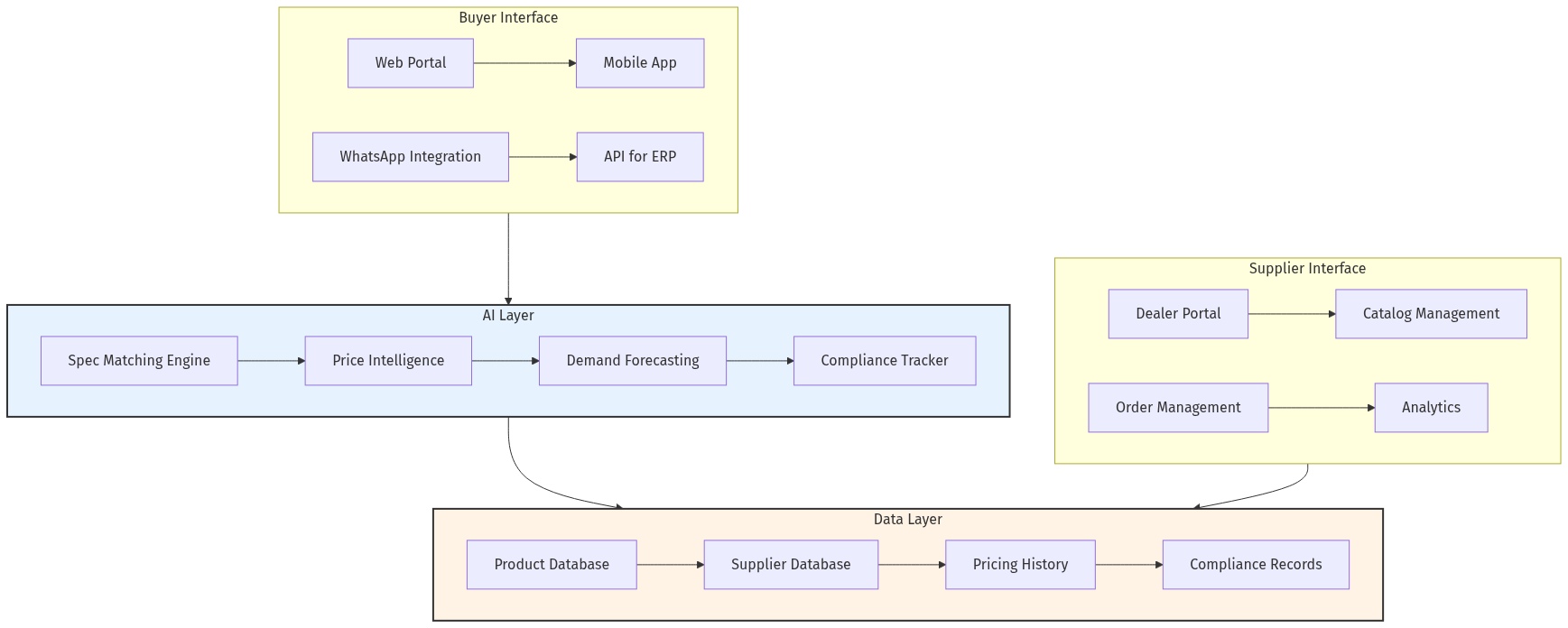
  • Product Architecture

    Product Architecture
    Product Architecture

    8.

    Development Plan

    PhaseTimelineDeliverables
    MVP8 weeksCatalog + search + basic quote request
    V112 weeksPrice comparison + supplier ratings + WhatsApp ordering
    V216 weeksAI spec matching + consumption analytics
    V320 weeksAuto-reorder + compliance automation + ERP integration

    MVP Features

  • Product catalog (10,000+ SKUs)
  • Supplier directory (500+ verified dealers)
  • Quote request system
  • Basic spend tracking
  • V1 Features

  • Multi-dealer price comparison
  • Supplier ratings and reviews
  • WhatsApp ordering flow
  • Basic analytics dashboard
  • V2 Features

  • AI specification matching
  • Consumption pattern analysis
  • Smart reorder recommendations
  • Mobile app
  • V3 Features

  • Full automation reordering
  • Compliance tracking and reporting
  • ERP/API integrations
  • Financial services (BNPL, invoice financing)

  • 9.

    Go-To-Market Strategy

    Phase 1: Dense Cluster Launch

    Target: Gujarat, Maharashtra, Tamil Nadu, Karnataka (60% of industrial PPE demand) Channels:
  • Trade shows — Safety & fire equipment exhibitions
  • Industrial associations — CII, FICCI, local manufacturing associations
  • Direct sales — Call on top 500 factories in target regions
  • WhatsApp groups — Join existing safety equipment dealer groups
  • Phase 2: Category Expansion

  • Add fall protection, fire safety, first aid categories
  • Partner with safety consultants and auditors
  • Integrate with corporate insurance providers
  • Phase 3: National Scale

  • Expand to all states
  • Add supplier financing
  • Launch B2C for SMBs
  • Initial Customer Acquisition

  • Safety managers at factories — Primary decision makers
  • Procurement heads — Budget owners
  • Plant managers — Influencers
  • EHS (Environment, Health, Safety) consultants — Key influencers

  • 10.

    Revenue Model

    Revenue StreamDescriptionPotential
    Commission8-15% on transactions₹20-50Cr ARR at scale
    Listing FeesPremium placement for suppliers₹2-5Cr ARR
    Premium SubscriptionsAnalytics, auto-reorder, compliance₹5-10Cr ARR
    FinancingInterest on BNPL, invoice discounting₹3-5Cr ARR
    AdvertisingBrand advertising from manufacturers₹1-2Cr ARR

    Unit Economics

    • ACV: ₹5-20 lakh (average factory annual PPE spend)
    • Sales cycle: 2-4 weeks for first order, then recurring
    • CAC: ₹50,000-1,50,000 (direct sales model)
    • LTV: ₹25-50 lakh (5-year relationship)
    • LTV:CAC: 10-20x (high retention, recurring purchases)

    11.

    Data Moat Potential

    This business accumulates powerful proprietary data:

  • Price intelligence database — Real-time pricing across India
  • Consumption patterns — Industry-wise, category-wise usage data
  • Supplier performance data — Delivery, quality, pricing over time
  • Compliance records — Audit-ready documentation
  • Specification mappings — Which products solve which hazards
  • Once established, this data creates significant barriers to entry — competitors would need years to build equivalent datasets.


    12.

    Why This Fits AIM Ecosystem

    Alignment with AIM Strategy

    • B2B marketplace: Core to AIM's discovery platform
    • Vertical specialization: Safety is a clear vertical
    • Offline-heavy: 90%+ transactions offline today
    • Fragmented suppliers: 1000s of small dealers, no platform
    • AI-native: Spec matching, demand forecasting, auto-reorder
    • India-scale: $15B market, growing 13% annually

    Expansion Path

    StageExpansion
    PPE→ Safety equipment
    → Industrial tools
    → Maintenance supplies
    → Factory consumables
    ---

    ## Verdict

    Opportunity Score: 8/10

    This is a large, fragmented, offline-heavy market with clear pain points. The specification matching barrier creates a natural moat for AI-first entrants. The challenge is supplier acquisition — dealers are traditional, slow to adopt tech.

    Key Strengths:
    • $15B market, 13% growth
    • 90%+ offline = massive digitization opportunity
    • Regulatory tailwind (safety compliance)
    • High LTV, recurring purchases
    Key Risks:
    • Supplier adoption challenges
    • Quality verification complexity
    • Competition from horizontal marketplaces
    Recommendation: Strong opportunity. Build MVP in one cluster (Gujarat), prove unit economics, then expand.

    ## Sources