ResearchFriday, April 3, 2026

AI-Powered Hotel & Restaurant Procurement: The $80B Opportunity Hidden in Kitchen Storages

India's 2.5 million hotels, restaurants, and canteens procure ingredients, supplies, and equipment through phone calls, manual market visits, and fragmented vendor networks. This $80B food service market is ripe for an AI-first B2B platform that can cut procurement costs by 15-25% while ensuring consistent quality across locations.

8
Opportunity
Score out of 10
1.

Executive Summary

India's food service procurement is broken. A mid-sized restaurant chain in tier-2 India spends 30+ hours weekly just coordinating supplies — calling vegetable vendors, comparing rates, managing deliveries, tracking payments. The wholesale markets (mandis) are chaotic, quality is inconsistent, and prices vary 40% between suppliers for identical produce.

The opportunity: Build an AI agent-powered procurement platform that acts as a buying co-pilot for hotels and restaurants. Not replacing traditional suppliers — but becoming the intelligent layer that aggregates demand, matches with verified suppliers, negotiates prices, and ensures quality consistency.

Target: 2.5 million+ food service establishments across India TAM: $80B (ingredients + supplies + equipment) Initial Focus: Tier 2-3 city restaurant chains, hotel groups, and institutional canteens
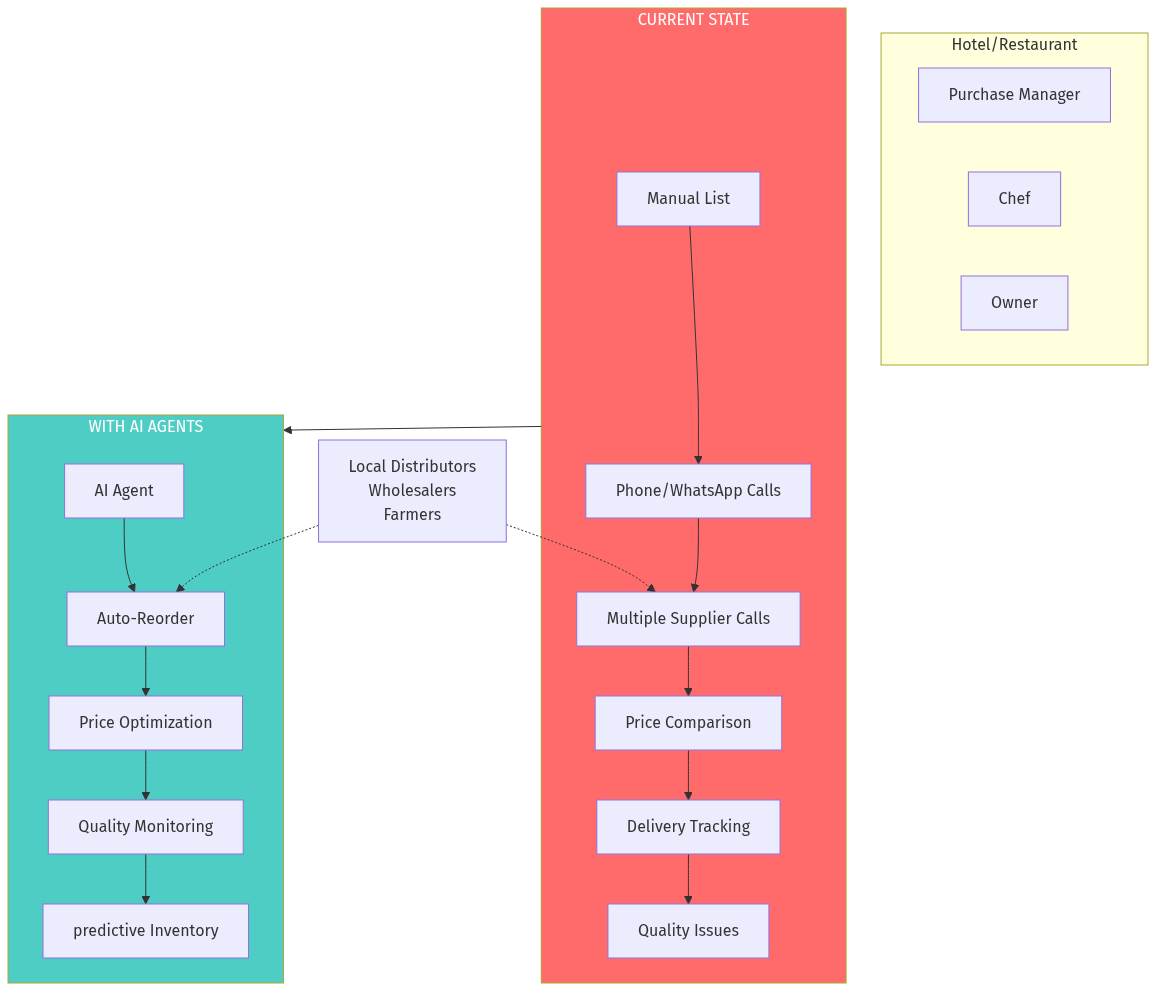
Procurement Flow
Procurement Flow
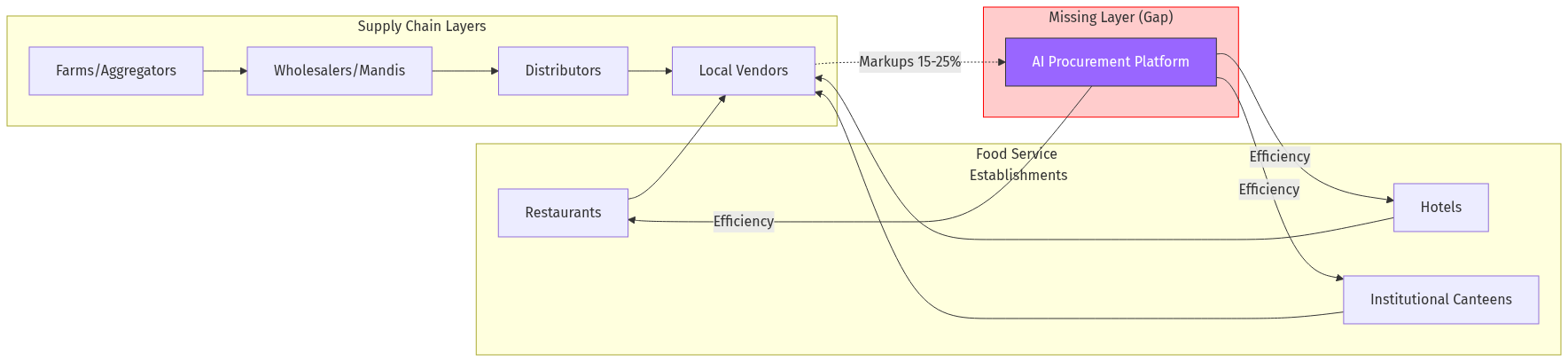
Supply Chain Gap
Supply Chain Gap

2.

Problem Statement

The Daily Reality

A 50-room hotel in Varanasi or a 100-seat restaurant in Coimbatore faces this every week:

  • Price discovery: Same quality tomatoes cost ₹25-45/kg depending on vendor and negotiation skill
  • Quality inconsistency: One delivery is excellent, next week same vendor delivers substandard
  • Time waste: Procurement manager spends 4 hours daily at wholesale market or on phone
  • Payment chaos: Multiple vendors, different payment terms, manual tracking
  • Inventory guessing: Over-order because lead times are unknown; throw away expired stock monthly
  • No data: No historical price trends, no quality tracking, no spending analytics

The Incentive Mess

Current system rewards:
  • Vendors who negotiate hardest, not those who deliver consistent quality
  • Procurement managers who find "deals" but don't track total cost of ownership
  • Hotels that treat procurement as cost center, not strategic advantage
Who profits from status quo?
  • Traditional wholesale traders (information asymmetry = margin)
  • Unorganized local suppliers (relationship-based, not data-based)
  • No transparency means room for negotiation margin at every step

3.

Current Solutions

CompanyWhat They DoWhy They're Not Solving It
Zomato HyperPureB2B food delivery for restaurantsOnly in major metros, focused on delivery, not comprehensive procurement
B2B BasketOnline grocery/supplies for businessesLimited geographic reach, not AI-powered
UdaanGeneral B2B marketplaceNot food-service specialized, no quality guarantees
JioMart PartnerB2B groceryNot focused on food service specifics

What's Missing

  • No AI-powered quality verification — computer vision for produce quality assessment
  • No predictive procurement — AI that learns consumption patterns and auto-reorders
  • No dynamic pricing — real-time market price tracking and negotiation
  • No quality history — vendor performance tracking over time
  • No multi-location optimization — consolidated procurement across branches

4.

Market Opportunity

Market Size

  • India Food Service Market: $80B (2025), growing 15% CAGR
  • Restaurant Procurement: $45B (ingredients alone)
  • Hotel Procurement: $25B (F&B + amenities + maintenance)
  • Institutional Canteens: $10B (schools, hospitals, corporate)

Growth Drivers

  • Rising food service establishments — 10% annual growth in restaurants
  • Professionalization — More organized chains vs. unorganized dhabas
  • FSSAI compliance pressure — Need documented supplier quality
  • Labor scarcity — Finding reliable procurement staff is hard
  • Cost pressure — Margins thin, need efficiency gains
  • Why Now

    • UPI payments — Digital transactions are normalized
    • Smartphone penetration — Even small vendors have WhatsApp
    • AI accessibility — LLMs can understand food-specific procurement logic
    • Cold chain expansion — Better logistics infrastructure
    • Post-COVID digitization — Food services more willing to adopt tech

    5.

    Gaps in the Market

    Gap 1: No Quality Standardization

    • No common quality grades for produce (unlike frozen foods)
    • Each chef defines quality differently
    • No objective measurement

    Gap 2: Fragmented Supply Chain

    • Multiple layers between farm and kitchen
    • Each layer adds 15-25% markup
    • No direct farm-to-hotel channels at scale

    Gap 3: No Data-Driven Procurement

    • Restaurants don't track cost per dish
    • No historical price analysis
    • No demand forecasting

    Gap 4: Institutional Blind Spot

    • Hostels, schools, hospitals, corporate canteens underserved
    • Government tender processes are manual
    • Bulk buyers have no aggregated platform

    Gap 5: No AI Agents in Procurement

    • Current "B2B platforms" are just catalogs
    • No intelligent automation
    • No conversational ordering

    6.

    AI Disruption Angle

    How AI Agents Transform the Workflow

    Today (Manual):
    Chef decides menu → Procurement calls vendors → Compare prices verbally 
    → Negotiate → Order → Delivery → Check quality → Payment → Record in notebook
    With AI Agents (Future):
    Chef: "Plan weekly menu for 100 covers, budget ₹45K"
    AI Agent: "Analyzes market prices, checks your quality history, finds optimal suppliers,
             places orders, verifies delivery quality via photos, processes payments,
             generates spending report"

    Specific AI Capabilities

  • Conversational Ordering — "Order 20kg tomatoes, quality A+ grade, deliver by Tuesday"
  • Quality Verification — Computer vision checks produce at delivery point
  • Price Prediction — ML predicts price trends, suggests optimal order timing
  • Vendor Scoring — Auto-tracks delivery time, quality consistency, pricing
  • Inventory Forecasting — Predicts consumption based on historical data + menu
  • Payment Automation — Auto-settlement on delivery confirmation
  • Compliance Tracking — FSSAI documentation auto-generation
  • The Agent Transaction Model

    When AI agents can transact:

    • Agents negotiate with agents (procurement AI talks to supplier AI)
    • Smart contracts execute on delivery confirmation
    • Dynamic pricing based on real-time supply/demand
    • Zero manual intervention for routine orders
    ---

    7.

    Product Concept

    Platform Name (Working): SupplyMate / FreshAI / ProcureChef

    Core Features

  • AI Procurement Assistant
  • - Chat interface for all procurement needs - Understands chef terminology ("padma shak" = okra, "bhari" = stuffed) - Multi-language support (Hindi, Tamil, Bengali, etc.)
  • Quality Assurance Layer
  • - Standardized quality grades (A+, A, B, C) - Photo-based verification at delivery - Vendor quality scorecard
  • Price Intelligence
  • - Real-time mandi price tracking - Price prediction for next week - Bulk discount optimization
  • Supplier Network
  • - Verified vendors by location and category - Direct farm connections for key items - Specialty suppliers for niche requirements
  • Analytics Dashboard
  • - Cost per dish calculation - Vendor comparison - Waste tracking - Budget vs actual
  • Inventory Management
  • - Auto-reorder suggestions - Expiry tracking - Consumption patterns

    User Experience

    For Hotel/Restaurant Owner:
    • Login → See today's orders → Chat: "What should I order for weekend?"
    • AI suggests based on historical data + current market
    • Approve with one tap → Orders placed → Track delivery
    For Vendor:
    • Receive orders on WhatsApp → Confirm → Deliver → Upload delivery photo
    • Get automatic payment within 24 hours
    • See performance score

    8.

    Development Plan

    PhaseTimelineDeliverables
    MVP8 weeksChat interface, 5 categories, 50 vendors, 1 city
    V112 weeksQuality verification, analytics, vendor app
    V216 weeksMulti-city expansion, AI forecasting, payments
    ScaleOngoingFarm-to-fork integration, institutional sales

    MVP Features

    • WhatsApp-first interface (most accessible for Indian users)
    • 5 pilot categories: Vegetables, Fruits, Dairy, Spices, Staples
    • Manual order matching initially, AI ranking
    • Cash on delivery (facilitate trust)

    Technical Stack

    • Frontend: React + WhatsApp Business API
    • Backend: Node.js + PostgreSQL
    • AI: OpenAI/Gemini for conversational, custom ML for pricing
    • Payments: Razorpay + UPI

    9.

    Go-To-Market Strategy

    Phase 1: Beachhead (Months 1-3)

    • Target: 50 restaurants in one tier-2 city (e.g., Indore)
    • Focus: Hotel management institutes (early adopters)
    • Channel: Direct sales + food industry events

    Phase 2: Expand (Months 4-8)

    • Target: 500 restaurants across 5 cities
    • Add: Hotel chains (bulk buyers)
    • Channel: Referral from early adopters

    Phase 3: Scale (Months 9-18)

    • Target: 5000+ establishments, institutional canteens
    • Add: B2B marketplace for vendors (flywheel effect)
    • Channel: Platform pull (vendors want access to buyers)

    Key Partnerships

    • Hotel association (FHRAI)
    • Restaurant association
    • Food delivery platforms (Zomato, Swiggy) — not compete, partner
    • FSSAI for compliance credibility

    Pricing Strategy

    • Free for restaurants (initially) — capture buyer side first
    • Commission from vendors — 2-5% onGMV
    • Premium features — Analytics, AI insights (₹2000-5000/month)

    10.

    Revenue Model

    Primary Revenue Streams

  • Vendor Commission — 2-5% on GMV processed
  • - Average restaurant spends ₹5L/month on groceries - 2% = ₹10,000/month per restaurant × 5000 = ₹5Cr monthly GMV = ₹1Cr revenue
  • Premium Subscriptions — ₹2000-5000/month
  • - AI forecasting, advanced analytics, quality reports - Target: 10% of restaurants = 500 × ₹3000 = ₹15L/month
  • Institutional Sales — Custom contracts
  • - Hospital, school, corporate canteens - Higher margins, longer sales cycle
  • Data Services — Market intelligence
  • - Sell anonymized pricing data to suppliers, investors - Niche but profitable

    Unit Economics

    • CAC: ₹3000 (restaurant) vs LTV: ₹1.2L over 3 years
    • Take rate: 2.5% average
    • Gross margin: 60%+ (software leverage)

    11.

    Data Moat Potential

    Proprietary Data Over Time

  • Price Intelligence
  • - Real prices paid across thousands of transactions - Competitors can't replicate
  • Quality Performance
  • - Vendor quality scores - Restaurant satisfaction data - Unique in Indian market
  • Consumption Patterns
  • - What restaurants actually order vs. menu - Seasonal demand patterns - Waste analytics
  • Supplier Network
  • - Verified supplier database - Coverage metrics

    Network Effects

    • More restaurants → better prices from vendors
    • More vendors → better selection for restaurants
    • Data → better AI → better service → more adoption

    12.

    Why This Fits AIM Ecosystem

    Vertical Integration

    This can become a vertical under AIM.in — "Food Service" category across all cities
    • Vizag restaurants → vizag.in/restaurants/
    • Chennai hotels → chennai.in/hotels/
    • Unified discovery + procurement

    Synergies

    • AIM.in listing — Restaurants already listed on AIM can get procurement
    • RCC pipes connection — Hotels need kitchen infrastructure
    • Trust signals — AIM.in ratings for restaurants

    Expansion Path

  • Start with procurement (transactional)
  • Add listing (discovery)
  • Add reviews (trust)
  • Add financing (capital)
  • Add staffing (HR)

  • ## Verdict

    Opportunity Score: 8/10

    This is a massive, fragmented market with clear pain points and a clear path to monetization. The AI angle is genuine — current solutions are just digitizing catalogs, not enabling intelligent procurement. The timing is right with UPI, smartphone penetration, and professionalization of food service.

    Risks:
    • Low margins in food service → unit economics sensitive
    • Vendor adoption is hard (traditional, low-tech)
    • Quality verification is complex
    • Competition from Zomato/Uber (if they expand)
    Why this wins:
    • Focus on tier 2-3 (under-served)
    • AI-first (competitors are digitizing old processes)
    • Hotel + restaurant + institutional (not just restaurants)
    Recommendation: Build MVP in one city first, prove unit economics, then scale. Target 500 restaurants within 12 months.

    ## Sources