AI-Powered Third-Party Testing Services Procurement: The Invisible $250B Market Ripe for Disruption
Every product that ships has been tested. Every building material certified. Every food item analyzed. Yet the process of finding and hiring the right testing lab remains stuck in the 1990s — phone calls, spreadsheets, and crossed fingers. AI agents are about to change everything.
1.
Executive Summary
Third-party testing and inspection services represent a $250+ billion global market — yet it operates like a cottage industry. SMBs struggle to find accredited labs, compare quotes, understand turnaround times, or verify credentials. The result? Overpaying for testing, missing compliance deadlines, and building relationships based on who you happen to know rather than who's actually best for the job.
This deep dive examines how AI-powered procurement intelligence can transform third-party testing services — creating a structured marketplace where SMBs can discover, compare, and procure testing services as easily as they book a hotel room.
The core insight: Testing isn't a commodity. It's a complex matching problem where requirements (material type, standards, accreditations, geography, timeline) must align with lab capabilities. AI agents excel at exactly this kind of multi-dimensional matching.
2.
Problem Statement
Who Experiences This Pain?
Manufacturing SMBs: A small electronics manufacturer in Pune needs EMC testing for export compliance. They don't know which labs are IEC certified, what tests are required for EU vs. US markets, or how to interpret results. They end up calling the same lab they've always used — regardless of whether it's the best fit.
Food Producers: A packaged food startup needs FSSAI-compliant lab testing for nutritional labeling. They find 50 labs on Google, but can't determine which are NABL-accredited, what the turnaround times are, or if the lab has experience with their specific product category.
Construction Companies: A builder needs concrete cube testing and soil analysis for a government project. They need labs with specific BIS certifications, NABL scope, and the ability to provide legally admissible reports. Finding qualified labs within their timeline is nearly impossible.
Exporters: An exporter needs pre-shipment testing that meets destination country requirements. They need to understand equivalency between Indian and international accreditations — a nightmare without specialized knowledge.
The Fragmentation Problem
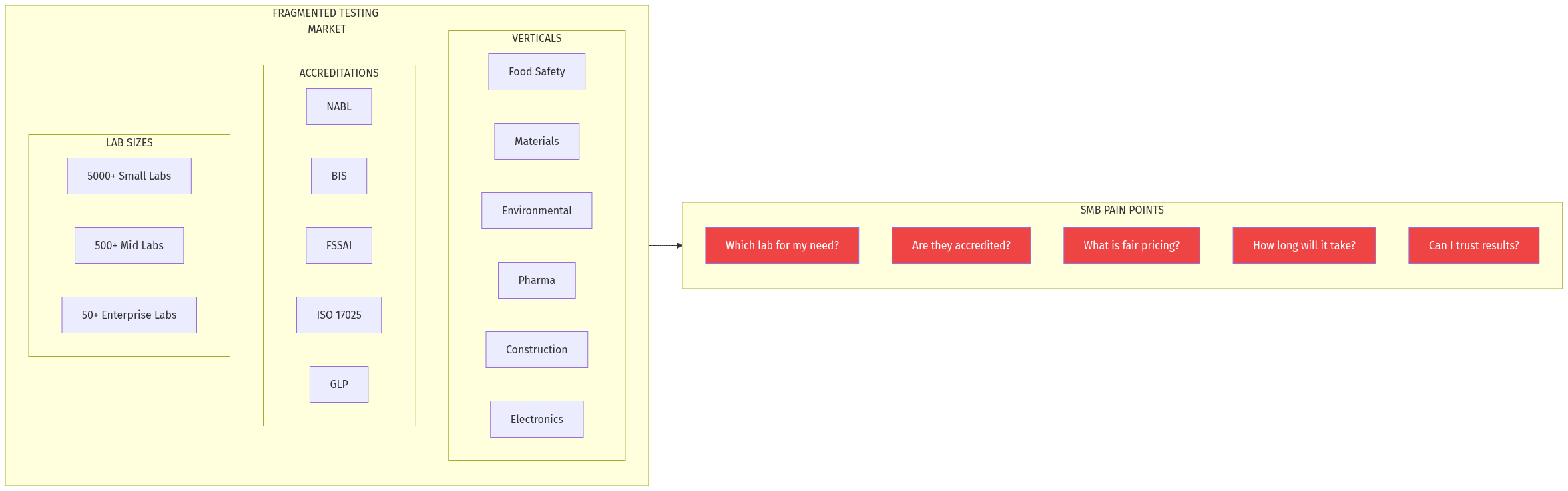
Testing Market Fragmentation
India alone has:
5,500+ NABL-accredited laboratories across multiple scopes
400+ BIS-approved testing centers
2,500+ FSSAI-notified laboratories
Thousands of unaccredited labs offering cheaper rates
These labs are:
Scattered across geographies with no unified directory
Operating different accreditation scopes (a lab accredited for water testing may not be accredited for soil)
Varying wildly in turnaround time (3 days to 3 weeks for the same test)
Pricing opaquely (quotes range 3-5x for identical tests)
Current Workflows Are Broken
Current vs Future WorkflowToday's Process:
Google search "EMC testing lab Mumbai"
Visit 10 websites, none with transparent pricing
Email 5 labs, get 2 responses in 3 days
Receive quotes in incomparable formats
Manually verify accreditation on NABL/BIS websites
Ship samples with no tracking
Chase labs for status updates
Receive certificates, store in email folders
Time to procure: 2-4 weeks
Comparison quality: Poor
Confidence level: Low
Make in India: Domestic manufacturing needs quality assurance infrastructure
Why Now?
AI maturity: Natural language processing can finally understand "I need to test my spice powder for heavy metals and aflatoxins for export to EU"
Digital payments: UPI enables instant lab payments
Cloud infrastructure: Labs can integrate digitally
COVID acceleration: Remote sample submission, digital certificates became normalized
5.
Gaps in the Market
Applying Anomaly Hunting
What's strange: The TIC market has consolidation at the top (Intertek, Bureau Veritas, SGS control 60%+ of enterprise business) but the SMB segment remains completely fragmented. Why hasn't a marketplace emerged?
Answer: Testing is not a commodity. It requires:
Understanding regulatory requirements
Matching accreditation scopes to specific tests
Translating customer requirements into lab capabilities
Managing chain-of-custody for samples
These are complex orchestration problems that general marketplaces can't solve. But AI agents can.
Specific Gaps
Discovery Intelligence: No platform helps SMBs understand WHAT testing they need. Most don't know the difference between NABL and BIS, or why accreditation matters.
Requirement Translation: Customers know their problem ("I'm exporting garments to Germany"), not the solution (REACH compliance testing, azo dye analysis, fiber content verification).
Accreditation Scope Matching: A lab might be NABL-accredited but not for your specific test. This requires parsing accreditation certificates — tedious work that AI can automate.
Timeline Optimization: Urgent testing commands premium pricing. But customers don't know which labs have capacity. Real-time availability would unlock pricing efficiency.
Quality Reputation: No TripAdvisor for labs. Customers rely on word-of-mouth when data-driven reputation scoring would serve them better.
6.
AI Disruption Angle
Zeroth Principles Analysis
Axiom we're questioning: "Finding the right lab requires industry expertise and relationships."
Zeroth principle insight: What if the expertise could be encoded? What if an AI agent could understand regulations, match accreditations, and recommend labs better than a human procurement manager?
How AI Agents Transform This
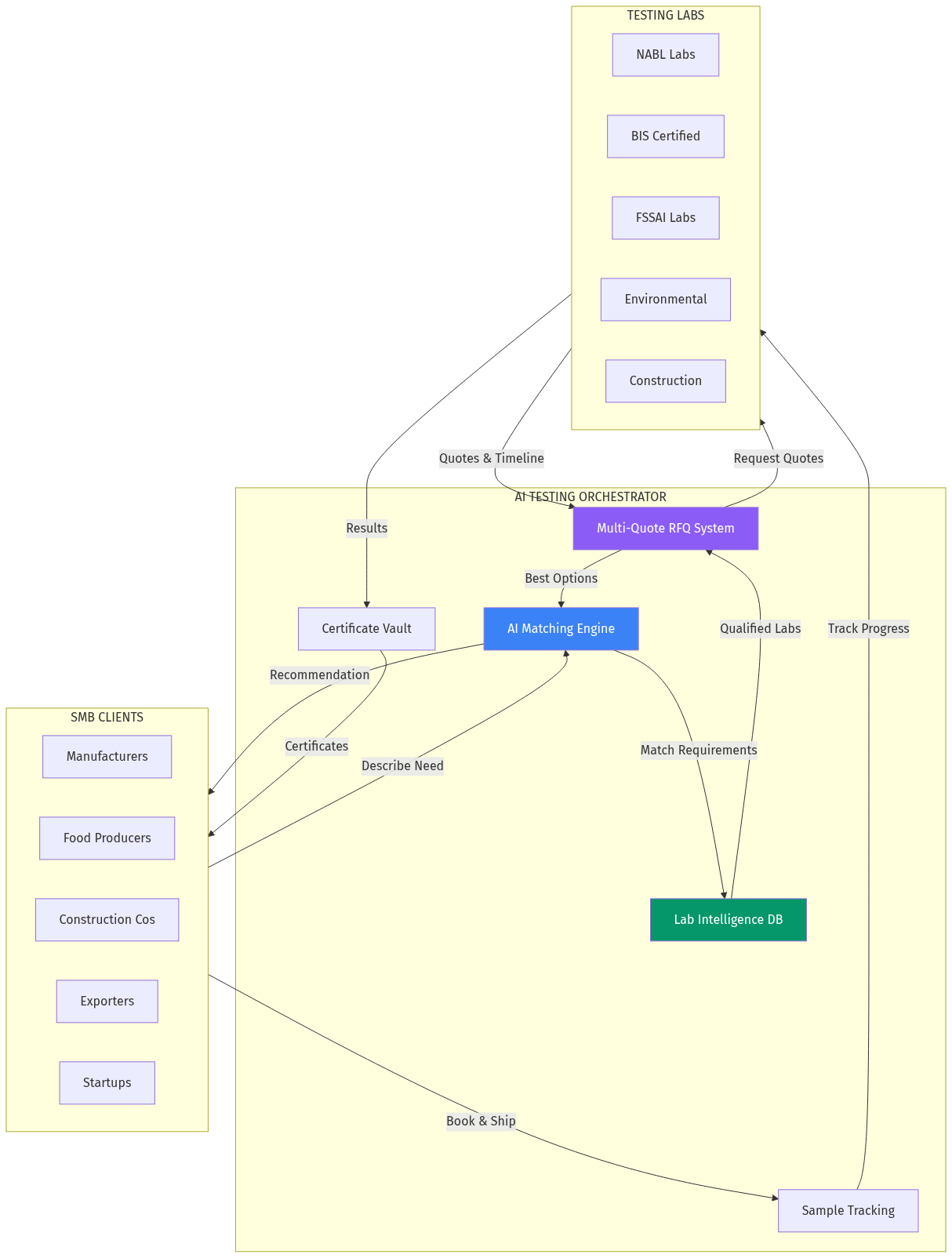
Platform Architecture1. Conversational Discovery
Customer: "I manufacture steel utensils and want to export to UAE"
AI: "For UAE export, you'll need ISI marking certification plus specific
     heavy metal migration tests. For your product category, I recommend
     NABL-accredited labs with metals testing scope. I found 7 qualified
     labs within 50km of your location. Would you like me to get quotes?"
2. Intelligent Matching
Parse NABL accreditation certificates (PDFs) to extract exact test scopes
Match customer requirements to lab capabilities automatically
Consider geography, turnaround time, price history, reputation
3. Multi-Quote Orchestration
Send standardized RFQs to multiple labs simultaneously
Normalize responses into comparable format
Present recommendation with rationale
4. Proactive Compliance
Alert customers when certifications expire
Notify about regulatory changes affecting their products
Suggest required tests based on customer profile
Distant Domain Import
Parallel from logistics: How Flexport transformed freight forwarding.
Freight forwarding was relationship-driven, opaque, and fragmented — just like testing services. Flexport applied software intelligence to:
Automate quote comparison
Provide shipment visibility
Simplify documentation
The same playbook applies to testing services.
7.
Product Concept
Core Platform
TestMitra — AI-powered testing services procurement platform
Tagline: "Find, compare, and book testing services in minutes, not weeks."
Key Features
For Customers (SMBs):
Describe your testing need in plain language
Get AI-powered lab recommendations
Compare quotes side-by-side
Book and pay online
Track sample status
Store certificates in cloud vault
Get renewal/re-testing reminders
For Labs:
List services with clear scope and pricing
Receive qualified leads (no tire-kickers)
Accept bookings with capacity management
Submit results through platform
Build reputation through verified reviews
Workflow
Describe Need: "I make ceramic tiles and need testing for ISI certification"
AI Processing: Platform identifies IS 15622 standard, required tests (water absorption, breaking strength, abrasion resistance), and NABL scope requirements
Lab Matching: Filters 5,500 NABL labs → 23 with ceramics testing scope → 8 within customer geography
Quote Request: Sends standardized RFQ to matched labs
Comparison: Presents quotes with turnaround time, price, reputation score
Booking: Customer selects, pays advance, gets sample shipping instructions
Tracking: Real-time sample and test status updates
Delivery: Digital certificate with blockchain verification option
Compliance graph: Know what testing every product category needs
Steelmanning: Why Incumbents Might Win
Counter-argument 1: "Big TIC companies will copy this."
Response: Intertek/Bureau Veritas are optimized for enterprise. SMB self-service cannabilizes their high-margin relationship business. They won't do it.
Counter-argument 2: "Labs won't share pricing."
Response: Labs already share pricing — via email, one customer at a time. Platform makes this efficient, not public.
Counter-argument 3: "Testing is too complex for AI."
Response: Complexity is exactly why AI helps. The matching logic can be encoded; humans can't hold 5,500 lab capabilities in their heads.
10.
Revenue Model
Transaction Fee Model
Service
Revenue
Booking fee (% of test cost)
8-12%
Expedited matching
₹500/request
Bulk/subscription plans
₹5,000-25,000/month
Compliance calendar (annual)
₹2,500/product line
Ancillary Revenue
Service
Revenue
Featured lab listings
₹10,000/month
Lead generation (pay-per-quote)
₹200-500/quote
Certification verification API
₹5/verification
Training (understanding test requirements)
₹15,000/workshop
Unit Economics Target
Average order value: ₹15,000
Take rate: 10%
Revenue per transaction: ₹1,500
CAC target: ₹500 (SEO + WhatsApp)
LTV (3 tests/year × 3 years): ₹13,500
LTV:CAC: 27x
11.
Data Moat Potential
What Accumulates Over Time
Lab Performance Data: Actual turnaround times, not promised. Quality scores based on re-test rates.
Pricing Intelligence: Historical pricing for every test type, by geography, by lab category. Benchmark data becomes invaluable.
Requirement Graph: Which products need which tests for which markets. A compliance knowledge graph.
Regulatory compliance expertise needed for credibility
Enterprise segment may resist (stick with big TIC)
Recommendation
BUILD THIS.
Testing services procurement is exactly the kind of "invisible infrastructure" market that AIM.in should own. The inefficiency is obvious. The AI application is natural. The data moat is substantial. And no one is focused on the SMB segment.
Start with food testing (FSSAI labs are most numerous, SMBs most underserved) and expand to industrial testing. The NABL directory is the starting point — parse, enrich, and make it intelligent.