AI-Powered Legacy Code Modernization: The $300B Enterprise Transformation Opportunity
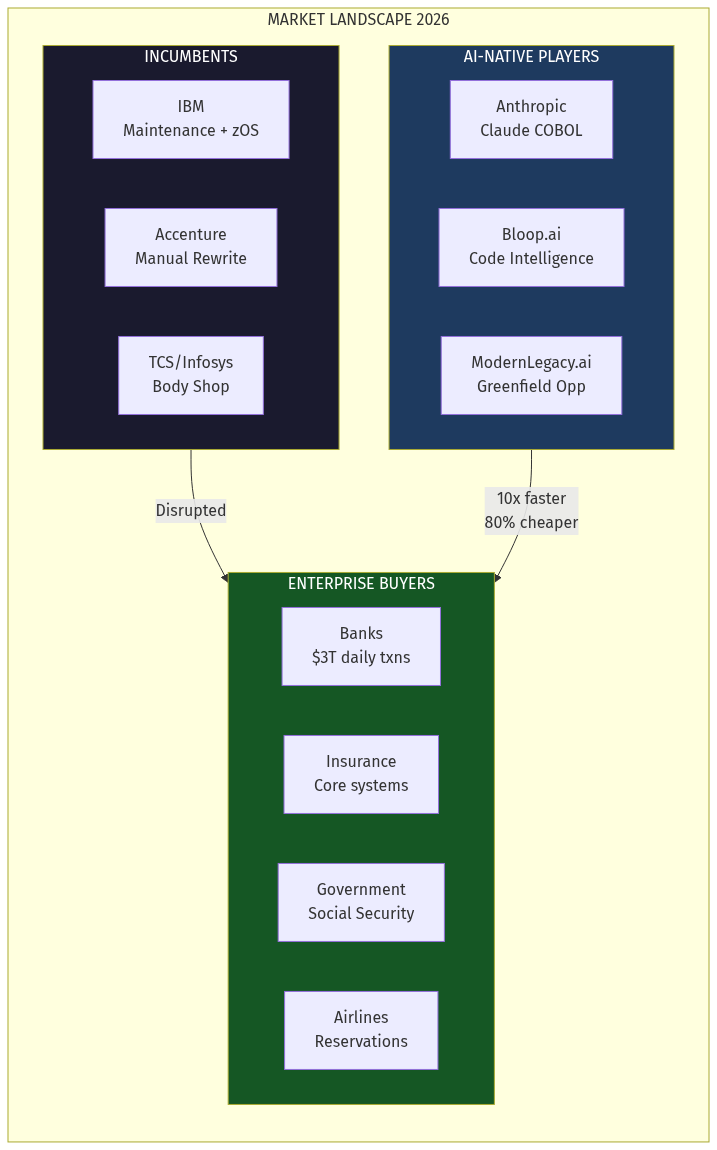
When Anthropic announced COBOL modernization tools and IBM's stock dropped 13% in a single day—the worst since 2000—it wasn't just market volatility. It was the starting gun for the most significant enterprise software transformation since the client-server revolution. Hundreds of billions of lines of legacy code running $3 trillion in daily transactions are suddenly within reach of AI-powered modernization.
1.
Executive Summary
Legacy code modernization represents one of the largest untapped opportunities in enterprise software. An estimated 220+ billion lines of COBOL alone process 95% of ATM transactions, most insurance claims, and virtually all government benefit payments. The workforce that maintains these systems has an average age exceeding 55, and fewer than a dozen universities still teach COBOL.
For decades, modernization projects have been synonymous with failure—multi-year timelines, billion-dollar budgets, and spectacular crashes like TSB Bank's £330M disaster. But AI is changing the calculus. Anthropic's February 2026 announcement demonstrated that AI can now understand, translate, and validate legacy code at a pace previously impossible, cutting project timelines from years to months and costs by 80%.
This creates a greenfield opportunity for AI-native modernization platforms that can serve the estimated $300B legacy modernization market while incumbents scramble to adapt.
Architecture Overview
2.
Problem Statement
The Legacy Code Crisis
Who experiences this pain?
CIOs and CTOs facing talent extinction: The average COBOL programmer is 58 years old. Universities stopped teaching it decades ago. Every retirement creates an irreplaceable knowledge gap.
CFOs managing mounting maintenance costs: Banks spend 60-80% of IT budgets maintaining systems, not innovating. A single COBOL programmer can command $150-200/hour due to scarcity.
Regulators and auditors demanding modernization: New compliance requirements (real-time reporting, API access) are nearly impossible on 60-year-old architectures.
Business leaders blocked from innovation: Can't launch mobile banking features when core systems require green-screen terminal access.
ZEROTH PRINCIPLES Analysis
Before accepting the conventional wisdom, we must question the fundamental axioms:
Axiom challenged: "Legacy systems should be replaced because they're old."
Zeroth principle insight: Age isn't the problem. The problems are: (1) knowledge concentration risk in aging workforce, (2) velocity—legacy can't iterate at modern pace, and (3) integration tax—every new feature requires complex adapters.
If we had infinite COBOL talent and zero integration requirements, these systems would run for another 60 years. They're remarkably stable. The crisis isn't technical—it's human capital and velocity.
The Numbers
Metric
Scale
Lines of COBOL in production
220+ billion
Daily transaction value (COBOL)
$3 trillion
Fortune 500 companies with COBOL
95%
Average COBOL programmer age
58
Universities teaching COBOL
<12 globally
Annual COBOL maintenance spend
$75-100B
---
3.
Current Solutions
Existing Approaches and Their Limitations
Company
Approach
Typical Timeline
Cost
Why It Fails
IBM
Maintain-in-place + z/OS
Indefinite
$10-50M/year
Kicks can down road; talent crisis still hits
Accenture/Deloitte
Manual rewrite ("Big Bang")
3-7 years
$100M-1B+
Massive risk; knowledge loss during transition
TCS/Infosys
Body shop translation
2-5 years
$50-200M
Still manual; quality varies; tribal knowledge lost
Micro Focus
COBOL-in-cloud wrapper
6-18 months
$5-30M
Doesn't solve technical debt; still COBOL underneath
AWS Mainframe Modernization
Automated refactoring
1-2 years
$20-80M
Limited by rule-based translation; misses business logic
INCENTIVE MAPPING: Who Profits from Status Quo?
Understanding why transformation hasn't happened requires mapping the incentives:
IBM's incentive: Mainframe licensing and maintenance generates ~$6B annually. Every modernization project is lost revenue. Their "modernization" solutions keep you on z/OS.
System integrators' incentive: Multi-year, time-and-materials projects are profit centers. Fast, AI-driven modernization threatens the business model.
Internal IT's incentive: Legacy specialists have job security precisely because the systems are complex. Simplification threatens positions.
Result: A $300B market where every major stakeholder profits from the status quo continuing.
4.
Market Opportunity
Total Addressable Market
Legacy Modernization Market: $300B globally
Segment
Size
Growth
Financial Services
$120B
8% CAGR
Government
$65B
12% CAGR
Insurance
$45B
7% CAGR
Manufacturing
$35B
9% CAGR
Healthcare
$25B
11% CAGR
Airlines/Travel
$10B
6% CAGR
Why Now?
1. AI capability threshold crossed: Anthropic's February 2026 announcement proved AI can understand COBOL semantics, not just syntax. This is the breakthrough—previous tools could parse code but couldn't extract business logic.
2. Talent cliff accelerating: COVID accelerated retirements. The COBOL workforce that was "problem for 2030" became "crisis in 2025."
3. Regulatory pressure intensifying: Open Banking, instant payments, real-time compliance reporting—all require API-first architectures impossible on mainframes.
4. Cloud economics compelling: AWS/Azure/GCP offer 60-80% cost savings vs. mainframe, but only with properly modernized (not wrapped) code.
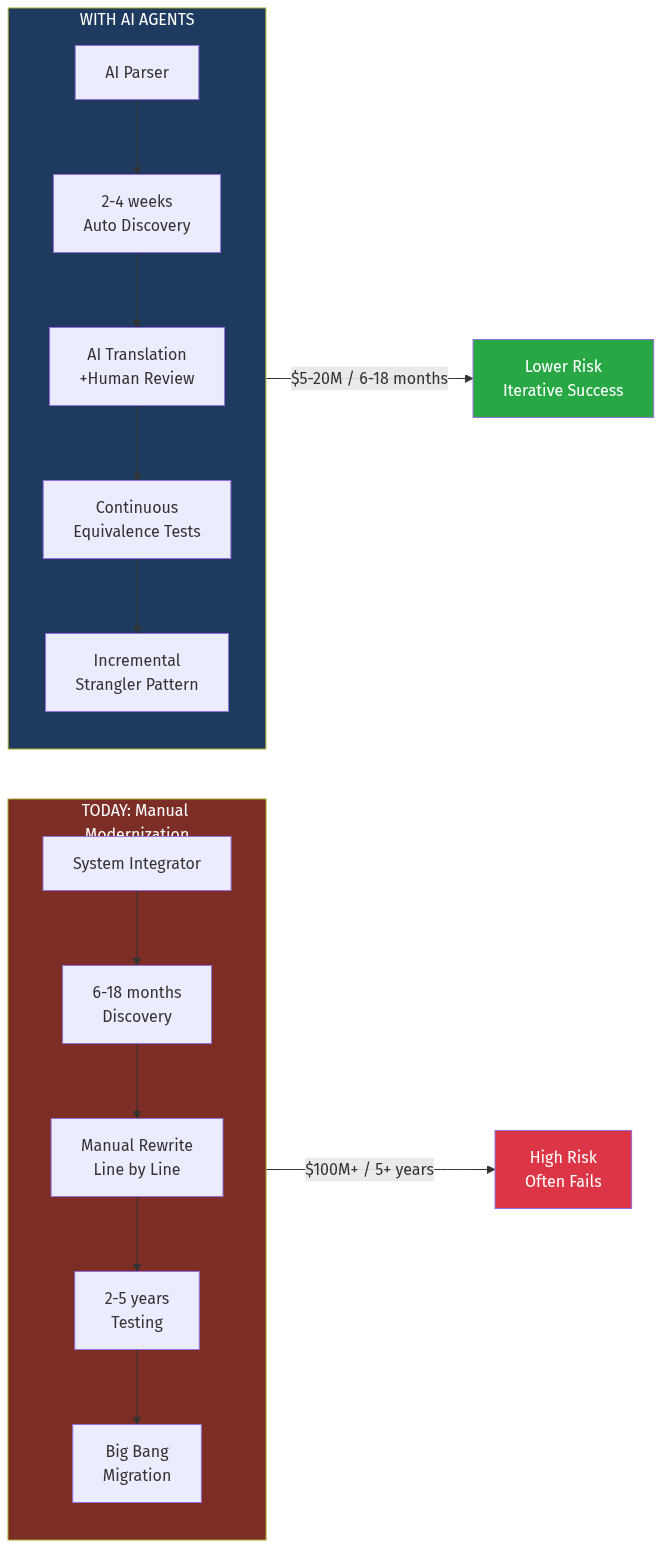
5. AI makes strangler pattern viable: Instead of "Big Bang" migrations that fail, AI enables incremental replacement—translating one module at a time with equivalence testing.
Modernization Flow Comparison
5.
Gaps in the Market
What Current Players Miss
Gap 1: Business Logic Extraction
Existing tools translate syntax (COBOL to Java) but lose semantic meaning. A PERFORM VARYING loop becomes a for-loop, but why that loop exists—the business rule—is lost.
Gap 2: Tribal Knowledge Capture
60 years of undocumented decisions live in programmers' heads. When they retire, that knowledge vanishes. No tool captures institutional memory.
Gap 3: Equivalence Assurance
How do you prove the new system produces identical outputs? Current approaches rely on parallel-run testing that takes months and catches only known scenarios.
Gap 4: Incremental Migration Path
"Big Bang" replacements fail because they're all-or-nothing. The market needs strangler-pattern tools that replace one service at a time with instant rollback.
Gap 5: Ongoing Translation Intelligence
After initial modernization, business rules change. Who updates both legacy and modern simultaneously during transition? This dual-maintenance hell kills projects.
ANOMALY HUNTING: What's Strange Here?
Anomaly: Despite decades of "urgent" modernization needs, success stories are rare. Why?
Insight: Every successful modernization we researched shared one trait: they didn't try to preserve the legacy architecture. They extracted business capabilities and rebuilt from scratch. The failures tried to "translate" code structure.
This suggests the opportunity isn't in better translation tools—it's in better capability extraction and reconstruction.
6.
AI Disruption Angle
How AI Agents Transform the Workflow
Traditional Approach:
Hire expensive consultants for 6-18 month "discovery"
Manually document every program (often 10,000+ programs)
Line-by-line rewrite by offshore teams
2-5 years of testing and debugging
"Big Bang" cutover (pray it works)
AI-Native Approach:
AI Parser ingests entire codebase in days, building semantic graph
Business Logic Extractor identifies capabilities vs. implementation details
AI Translator generates modern code with embedded test cases
Equivalence Engine runs continuous validation against production outputs
Strangler Orchestrator routes traffic incrementally to new services
DISTANT DOMAIN IMPORT: What Other Fields Solved This?
Language Translation (Human Languages):
For decades, machine translation was rule-based and terrible. The breakthrough came when systems stopped translating words and started translating meaning. Neural MT understands intent, not just grammar.
Application to Code: The same paradigm shift applies. Stop translating COBOL syntax to Java syntax. Extract business intent and express it in modern idioms.
Genome Sequencing:
Bioinformatics faced similar scale: billions of base pairs, complex interactions, need for accuracy. Solution: break into smaller problems (genes), analyze patterns, reconstruct understanding.
Application: Don't modernize monoliths. Identify "code genes" (bounded contexts), extract them individually, test independently.
7.
Product Concept
ModernLegacy.ai — The AI-Native Modernization Platform
Core Value Proposition: Turn 5-year, $100M+ modernization projects into 12-month, $10-20M iterative transformations with guaranteed equivalence.
Identify "code genes" (bounded business capabilities)
Score each gene by complexity, risk, business value
2. Knowledge Capture System
AI conducts video interviews with senior programmers
Extracts undocumented business rules and edge cases
Links tribal knowledge to specific code sections
Creates searchable institutional memory
3. Intelligent Translation Engine
Generates modern code (Java, Python, Go, Rust)
Preserves business semantics, not syntax
Embeds comprehensive test suites
Produces human-readable documentation
4. Continuous Equivalence Testing
Runs production traffic through both systems
Compares outputs with configurable precision
Flags semantic drift immediately
Builds confidence score over time
5. Strangler Pattern Orchestrator
Routes requests to legacy or modern based on confidence
Enables gradual, reversible migration
Zero-downtime cutover when ready
Instant rollback if issues emerge
User Interface
For Technical Teams: IDE plugins that show legacy-to-modern mappings, explain translations, surface test coverage.
For Executives: Dashboard showing migration progress, risk scores, cost savings, confidence metrics.
For Compliance: Audit trail of every translation decision, test result, and deployment.
8.
Development Plan
Phase 1: MVP — Code Intelligence (3 months)
Deliverable
Description
COBOL Parser
AST analysis + semantic graph generation
Dependency Mapper
Call graphs, data flows, program relationships
Complexity Scorer
Risk/effort estimation per module
Basic Web UI
Upload code, view analysis, export reports
Success Metric: Parse 1M lines of COBOL in <1 hour with 99% accuracy.
Phase 2: Translation Engine (4 months)
Deliverable
Description
AI Translator
COBOL → Java with test generation
Knowledge Capture
Interview transcription + linking
Equivalence Tester
Output comparison framework
Enterprise Pilot
2-3 mid-size bank engagements
Success Metric: Translate 100K line module with 95% equivalence on first pass.
Phase 3: Production Platform (5 months)
Deliverable
Description
Multi-language Support
Add RPG, PL/I, FORTRAN
Strangler Orchestrator
Traffic routing + rollback
Compliance Module
SOC2, audit trails, approvals
Enterprise Scale
100M+ line codebases
Success Metric: Complete first full bank core-banking modernization.
9.
Go-To-Market Strategy
Beachhead: Regional Banks
Why regional banks?
Large enough to have serious COBOL (10-50M lines)
Small enough for faster decisions than money-center banks
Desperate for talent (can't compete with JPMorgan for COBOL devs)
Often failed previous modernization attempts
Regulatory pressure from OCC/FDIC to modernize
Channel Strategy
1. Direct Enterprise Sales
Target CIOs and CTOs at regional banks ($5-50B assets)
Provide platform; they provide implementation services
3. Cloud Provider Alliances
AWS, Azure, GCP all have mainframe modernization programs
Position as the AI layer in their modernization stack
Access their enterprise sales force and customer base
Pricing Model
Tier
Scope
Price
Assessment
Code analysis + roadmap
$50K one-time
Pilot
1M line module modernization
$500K
Platform
Full enterprise license
$2-5M/year
Managed
Platform + AI-guided services
$5-15M/year
---
10.
Revenue Model
Primary Revenue Streams
1. Platform Subscription (70% of revenue)
Annual license based on codebase size
$2-5M for mid-tier enterprises
$10-25M for large financial institutions
2. Professional Services (20% of revenue)
AI-guided implementation services
Knowledge capture workshops
Equivalence testing and validation
$300-500/hour blended rate
3. Ongoing Modernization (10% of revenue)
Continuous translation as business rules evolve
Dual-maintenance during transition periods
Change management and training
Financial Projections
Year
ARR
Customers
Gross Margin
1
$5M
10
65%
2
$25M
40
72%
3
$80M
100
78%
4
$200M
200
82%
5
$500M
400
85%
---
11.
Data Moat Potential
Proprietary Data Assets
1. Code Pattern Library
Every engagement adds to our understanding of legacy code patterns. With 100 bank engagements, we'll have seen virtually every COBOL idiom in financial services.
2. Translation Memory
Like human translation, reusable translations improve over time. A "calculate compound interest" pattern translated once is instantly available everywhere.
3. Equivalence Test Corpus
Millions of input/output pairs become the largest regression test suite for legacy modernization. No competitor can replicate this asset.
4. Tribal Knowledge Graph
Captured institutional memory from hundreds of 30+ year veterans. When they retire, that knowledge lives on in our system.
5. Risk Scoring Model
Which code patterns predict failed modernizations? With enough data, we can predict project risk before a line is written.
Network Effects
More customers → more patterns → better translations
1. B2B Enterprise Focus
Legacy modernization is the ultimate B2B play—multi-million dollar contracts, long sales cycles, deep integration requirements.
2. AI-Native Opportunity
This market can only be disrupted by AI. Traditional approaches have failed for decades. AI capability breakthrough makes this possible now.
3. India Execution Advantage
India has the world's largest pool of COBOL maintenance talent. An India-based modernization platform can offer 40-60% cost advantages while accessing this expertise.
4. AIM.in Portfolio Synergy
thefoundry.in: Industrial procurement often runs on legacy systems
networth.in: Financial services core systems are COBOL
challan.in: Government compliance systems are legacy
5. Recurring Revenue Model
Platform subscriptions + ongoing maintenance create predictable, high-margin revenue streams aligned with AIM.in's marketplace economics.
Potential Brand: legacy.in or modernize.in
## FALSIFICATION: Pre-Mortem Analysis
Why This Could Fail
Failure Mode 1: AI Translation Quality
If AI produces code that's 95% correct but 5% subtly wrong, enterprise trust collapses. Financial systems demand 99.999% accuracy.
Mitigation: Equivalence testing as core product. Never ship without mathematical proof of identical outputs.
Failure Mode 2: Incumbent Response
IBM or Accenture could acquire AI capabilities and bundle with existing relationships.
Mitigation: Move fast. First-mover advantage in training data creates defensible moat.
Failure Mode 3: Enterprise Sales Cycle
Banks take 12-24 months to buy. Cash burn during sales cycle could be fatal.
Mitigation: Start with assessments ($50K, fast close) to build pipeline while platforming for larger deals.
Failure Mode 4: Technical Complexity
COBOL has 60 years of edge cases, dialects, and vendor extensions. Underestimating this killed previous attempts.
Mitigation: Focus on common patterns first (80/20 rule). Handle edge cases with human-in-loop.
## STEELMANNING: The Case Against
Best argument for why incumbents win:
"Banks don't optimize for cost or speed—they optimize for risk. A failed modernization can destroy a bank (TSB lost £330M and their CEO). IBM's 'maintain in place' strategy has zero migration risk. For a risk officer, paying 3x for certainty beats paying 0.3x for 95% confidence. AI startups will always fail the risk test because they can't offer the contractual guarantees enterprises require."
Counter-argument:
True, but the risk calculation is changing. The risk of NOT modernizing (talent extinction, regulatory non-compliance, competitive obsolescence) now exceeds the risk of modernizing. And AI equivalence testing can provide mathematical guarantees no manual approach can match.
## Verdict
Opportunity Score: 9/10
This is a generational opportunity. The convergence of AI capability breakthrough, workforce crisis, regulatory pressure, and cloud economics creates a window that won't stay open forever. The IBM stock crash signals that markets recognize the disruption potential.
Why 9/10 (not 10/10)?
Enterprise sales cycles are brutal
Requires deep domain expertise (COBOL + AI + enterprise)
Capital intensive to reach scale
Regulatory/compliance overhead is significant
Recommendation
Build this. It requires significant capital and enterprise sales capability, but the market size ($300B), timing (AI breakthrough just happened), and incumbent vulnerability (IBM lost $31B in market cap in one day) make this among the most compelling B2B opportunities of 2026.
The winner in this market will become a new enterprise software giant—the Salesforce of infrastructure modernization.